SLT-THz100 Digital Lock-in Amplifier
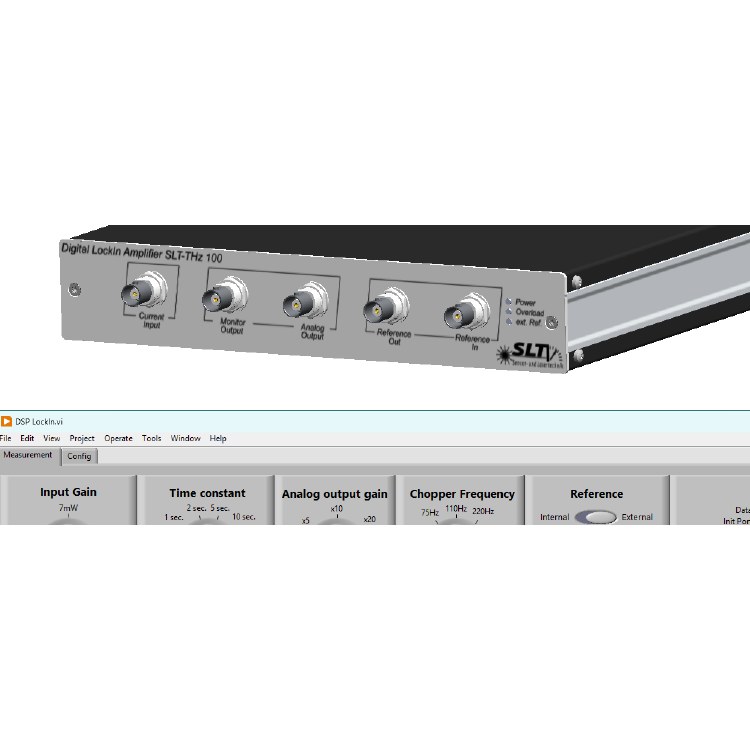
Overview
Sunpump offers the SLT-THz100 DSP lock-in amplifier optimized for THZ10/THZ20/THZ30 THz sensors and their high-sensitivity variants, enabling lock-in detection of weak THz signals with USB power and control, plus LabVIEW software interface.
Description
1. Overview
The SLT-THz100 DSP lock-in amplifier is optimized for evaluating signals from THZ10, THZ20 and THZ30 THz sensors and their high-sensitivity variants. The input is a current amplifier designed for the large sensor capacitances of THz sensors. This dual-phase lock-in determines the output signal for two phase shifts differing by 90°; Pythagorean addition makes the result phase-independent. First three harmonics can be displayed; the resultant of the fundamental frequency is always available at the BNC output.
2. Key Specifications
• Full scale sensitivity: 100 fA to 0.5 A
• Max. current: 10 mA damage threshold
• Gain accuracy: 1% (10 Hz to 200 Hz)
• Gain stability: 200 ppm/°C
• Low pass filter: 100 Hz/3 dB
• Dynamic reserve: 20/40/60 dB
• Reference frequency: 0.5 Hz to 1 kHz
• Reference input: 1.6 kΩ, dc coupled, galvanic isolated
• Analog output: ±5 V; monitor output ±10 V isolated
• Reference output: TTL, 5 V, 50% duty cycle
• USB interface: 2M baud, supplies device
• Dimensions: 250 × 240 × 50 mm
3. Typical Applications
Lock-in measurement of weak THz signals; THz detector signal evaluation; chopped THz power measurement; laboratory THz spectroscopy systems.
Specifications
| Full scale sensitivity | 100 fA to 0.5 A |
|---|---|
| Max. current | 10 mA damage threshold |
| Gain accuracy | 1% (10 Hz to 200 Hz) |
| Dynamic reserve | 20/40/60 dB |
| Reference frequency | 0.5 Hz to 1 kHz |
| Analog output | ±5 V amplitude; monitor ±10 V |
| Interface | USB 2M baud (power supply) |
| Dimensions | 250 × 240 × 50 mm |
Technical Data
Technical Data
Design: DSP dual-phase lock-in amplifier; current amplifier input designed for large THz sensor capacitances; other sensors (e.g. photodiodes) also possible.
Operation: Exclusively via PC software and USB interface; power supplied via USB.
Measurement: Dual-phase demodulation; Pythagorean addition gives phase-independent results; first three harmonics displayable; fundamental resultant always at BNC output.
Interfaces: Reference inputs/outputs TTL compatible and galvanically isolated; monitor output for sensor signal; analog outputs decoupled via isolation amplifiers.
Indication: Front-panel LEDs for readiness, selected reference source and overload.
Software: USB communication fully documented with simple ASCII commands; LabVIEW-based Windows interface included.