Low-Frequency Raman Spectroscopy System
1. Overview The Low-Frequency Raman (THz-Raman) System extends Raman spectroscopy from the traditional fingerprint region (approx. 200–2000 cm⁻¹) dow
Products
Sub-categories and products available in this range.
Description
Overview
1. Overview
The Low-Frequency Raman (THz-Raman) System extends Raman spectroscopy from the traditional fingerprint region (approx. 200–2000 cm⁻¹) down to the Terahertz/ultra-low-frequency regime (down to ~5 cm⁻¹), accessing the same energy transitions as THz spectroscopy (150 GHz–6 THz, i.e. 5–200 cm⁻¹) without limiting the fingerprint region — combining "chemical identification" and "structural analysis" in one system. No special sample preparation is required. The system is simple, affordable and portable, and is compatible with standard Raman laser sources (488–1064 nm) and existing Raman systems.
2. System Principle
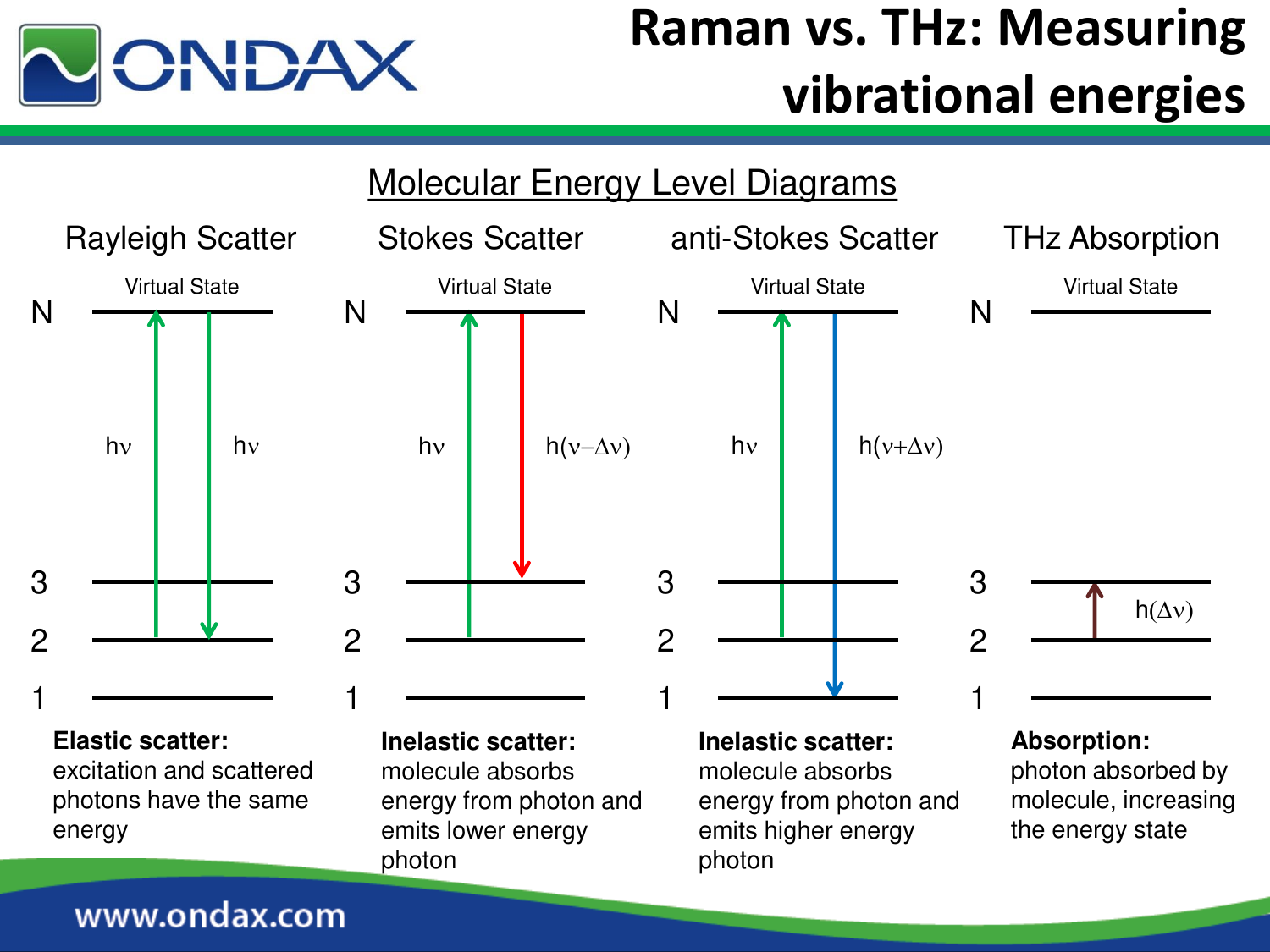
Raman spectroscopy probes molecular vibrations through inelastic scattering of incident photons. The molecular energy level diagram below illustrates four energy exchange processes: Rayleigh scattering (elastic — excitation and scattered photons have the same energy), Stokes scattering (the molecule absorbs energy from the photon and emits a lower-energy photon), anti-Stokes scattering (the molecule releases energy and emits a higher-energy photon), and THz absorption (the photon is absorbed, raising the molecule to a higher energy state). Low-frequency Raman exploits the low-frequency components near the excitation line to probe lattice vibrations, intermolecular modes and hydrogen bonding.
3. THz-Raman Coverage
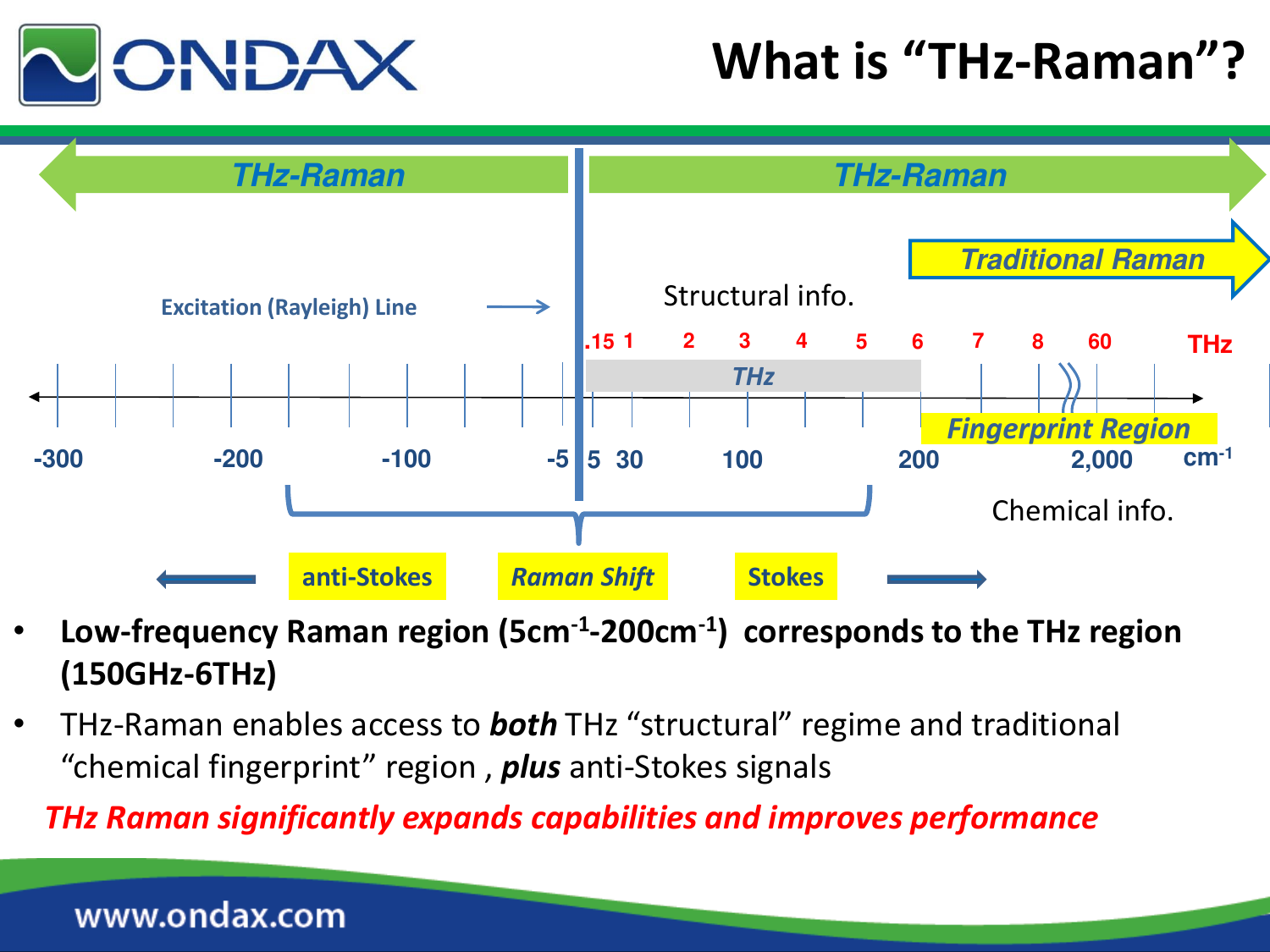
Traditional Raman focuses on the fingerprint region farther from the excitation (Rayleigh) line (above 200 cm⁻¹, chemical information). THz-Raman retains the fingerprint region while emphasizing the low-frequency Raman region near the excitation line (5–200 cm⁻¹, i.e. 150 GHz–6 THz, structural information), acquiring both Stokes and anti-Stokes signals. A single measurement provides BOTH the THz "structural" regime AND the traditional "chemical fingerprint" region — significantly expanding capabilities and improving performance.
4. Why Low Frequency/THz Matters
This regime contains important information about molecular/intermolecular structure, not just chemical composition:
· Crystallographic orientation/size (e.g. carbon allotropes: diamond, graphite, nanotubes, graphene)
· Polymeric chains — affecting optomechanical properties (transparency, strength, etc.)
· Polymorphic formulations of substances with identical chemical formulation (allotropes, conformers)
· Manufacturing, processing methods, forensic evidence
Low-frequency/THz signals improve sensitivity, accuracy and forensic value, providing additional, often highly differentiating data; anti-Stokes signals confirm low-frequency signals.
5. What Limits Traditional Raman
Most Raman systems focus on the fingerprint region (~200–2000 cm⁻¹). Current filter technology limits access to lower frequencies with a cutoff typically at ~200 cm⁻¹ (6 THz); other approaches are much more complex and difficult to operate; and the value of low-frequency information has historically been underestimated. THz-Raman recovers this lost information through ultranarrowband notch and ASE clean-up filters.
6. System Configuration
· Core filter module: SureBlock XLF-CLM ultranarrowband notch + ASE clean-up filter module, sealed optical design, wide operating temperature range
· Excitation source: compatible with standard Raman lasers (488–1064 nm); 532/785/808/830 nm options
· Spectrograph: high-sensitivity low-frequency Raman spectrograph, fiber-coupled, simultaneous Stokes/anti-Stokes acquisition
· Sampling accessories: vial adapters, free-space adapter, microscope adapter, immersion probes, etc.
· Simple, affordable, portable; low maintenance
7. Typical Applications
· Pharmaceutical analysis: polymorph/crystalline phase identification, drug development/formulation screening, process control, surety testing (e.g. carbamazepine — only Form 3 is FDA-approved; Forms 2/3 and hydrate are clearly differentiated in the low-frequency region in a single measurement; TPB electroluminescent material α/β/γ/δ polymorphs)
· Security, Defense & Law Enforcement: trace/standoff detection and forensic analysis of explosives, chem/bio agents, hazmats, drugs (ammonium nitrate — strong SNR in seconds with 532 nm; HMTD — strong signals in seconds with 785 nm)
· Petrochemical/Plastics & Industrial Chemicals: material characterization, polymorph identification, process control
· Life Sciences: disease detection/cell characterization, DNA structures and composition
· Forensics: gems, tissue, blood, art, counterfeiting
· Material Science/Research: photovoltaics and battery materials, semiconductors (e.g. strained Si), graphene layers and orientation, carbon nanotubes, polymorphism studies, crystal stress/strain, intermolecular bonding, in-situ temperature measurements, longitudinal acoustic modes and radial breathing modes
8. Service Support
Sunpump provides full-service support from requirement analysis and solution design to system integration, installation, commissioning and operator training, with excitation wavelength, sampling accessories and analysis needs customizable, timely after-sales response and long-term stable operation.
1. Overview
The Low-Frequency Raman (THz-Raman) System extends Raman spectroscopy from the traditional fingerprint region (approx. 200–2000 cm⁻¹) down to the Terahertz/ultra-low-frequency regime (down to ~5 cm⁻¹), accessing the same energy transitions as THz spectroscopy (150 GHz–6 THz, i.e. 5–200 cm⁻¹) without limiting the fingerprint region — combining "chemical identification" and "structural analysis" in one system. No special sample preparation is required. The system is simple, affordable and portable, and is compatible with standard Raman laser sources (488–1064 nm) and existing Raman systems.
2. System Principle
Raman spectroscopy probes molecular vibrations through inelastic scattering of incident photons. The molecular energy level diagram below illustrates four energy exchange processes: Rayleigh scattering (elastic — excitation and scattered photons have the same energy), Stokes scattering (the molecule absorbs energy from the photon and emits a lower-energy photon), anti-Stokes scattering (the molecule releases energy and emits a higher-energy photon), and THz absorption (the photon is absorbed, raising the molecule to a higher energy state). Low-frequency Raman exploits the low-frequency components near the excitation line to probe lattice vibrations, intermolecular modes and hydrogen bonding.
3. THz-Raman Coverage
Traditional Raman focuses on the fingerprint region farther from the excitation (Rayleigh) line (above 200 cm⁻¹, chemical information). THz-Raman retains the fingerprint region while emphasizing the low-frequency Raman region near the excitation line (5–200 cm⁻¹, i.e. 150 GHz–6 THz, structural information), acquiring both Stokes and anti-Stokes signals. A single measurement provides BOTH the THz "structural" regime AND the traditional "chemical fingerprint" region — significantly expanding capabilities and improving performance.
4. Why Low Frequency/THz Matters
This regime contains important information about molecular/intermolecular structure, not just chemical composition:
· Crystallographic orientation/size (e.g. carbon allotropes: diamond, graphite, nanotubes, graphene)
· Polymeric chains — affecting optomechanical properties (transparency, strength, etc.)
· Polymorphic formulations of substances with identical chemical formulation (allotropes, conformers)
· Manufacturing, processing methods, forensic evidence
Low-frequency/THz signals improve sensitivity, accuracy and forensic value, providing additional, often highly differentiating data; anti-Stokes signals confirm low-frequency signals.
5. What Limits Traditional Raman
Most Raman systems focus on the fingerprint region (~200–2000 cm⁻¹). Current filter technology limits access to lower frequencies with a cutoff typically at ~200 cm⁻¹ (6 THz); other approaches are much more complex and difficult to operate; and the value of low-frequency information has historically been underestimated. THz-Raman recovers this lost information through ultranarrowband notch and ASE clean-up filters.
6. System Configuration
· Core filter module: SureBlock XLF-CLM ultranarrowband notch + ASE clean-up filter module, sealed optical design, wide operating temperature range
· Excitation source: compatible with standard Raman lasers (488–1064 nm); 532/785/808/830 nm options
· Spectrograph: high-sensitivity low-frequency Raman spectrograph, fiber-coupled, simultaneous Stokes/anti-Stokes acquisition
· Sampling accessories: vial adapters, free-space adapter, microscope adapter, immersion probes, etc.
· Simple, affordable, portable; low maintenance
7. Typical Applications
· Pharmaceutical analysis: polymorph/crystalline phase identification, drug development/formulation screening, process control, surety testing (e.g. carbamazepine — only Form 3 is FDA-approved; Forms 2/3 and hydrate are clearly differentiated in the low-frequency region in a single measurement; TPB electroluminescent material α/β/γ/δ polymorphs)
· Security, Defense & Law Enforcement: trace/standoff detection and forensic analysis of explosives, chem/bio agents, hazmats, drugs (ammonium nitrate — strong SNR in seconds with 532 nm; HMTD — strong signals in seconds with 785 nm)
· Petrochemical/Plastics & Industrial Chemicals: material characterization, polymorph identification, process control
· Life Sciences: disease detection/cell characterization, DNA structures and composition
· Forensics: gems, tissue, blood, art, counterfeiting
· Material Science/Research: photovoltaics and battery materials, semiconductors (e.g. strained Si), graphene layers and orientation, carbon nanotubes, polymorphism studies, crystal stress/strain, intermolecular bonding, in-situ temperature measurements, longitudinal acoustic modes and radial breathing modes
8. Service Support
Sunpump provides full-service support from requirement analysis and solution design to system integration, installation, commissioning and operator training, with excitation wavelength, sampling accessories and analysis needs customizable, timely after-sales response and long-term stable operation.
Features
- [{"nameEn": "Low-Frequency Raman Detection"}]