Dual-wavelength Transient Interference Detection System
Overview
1. Overview
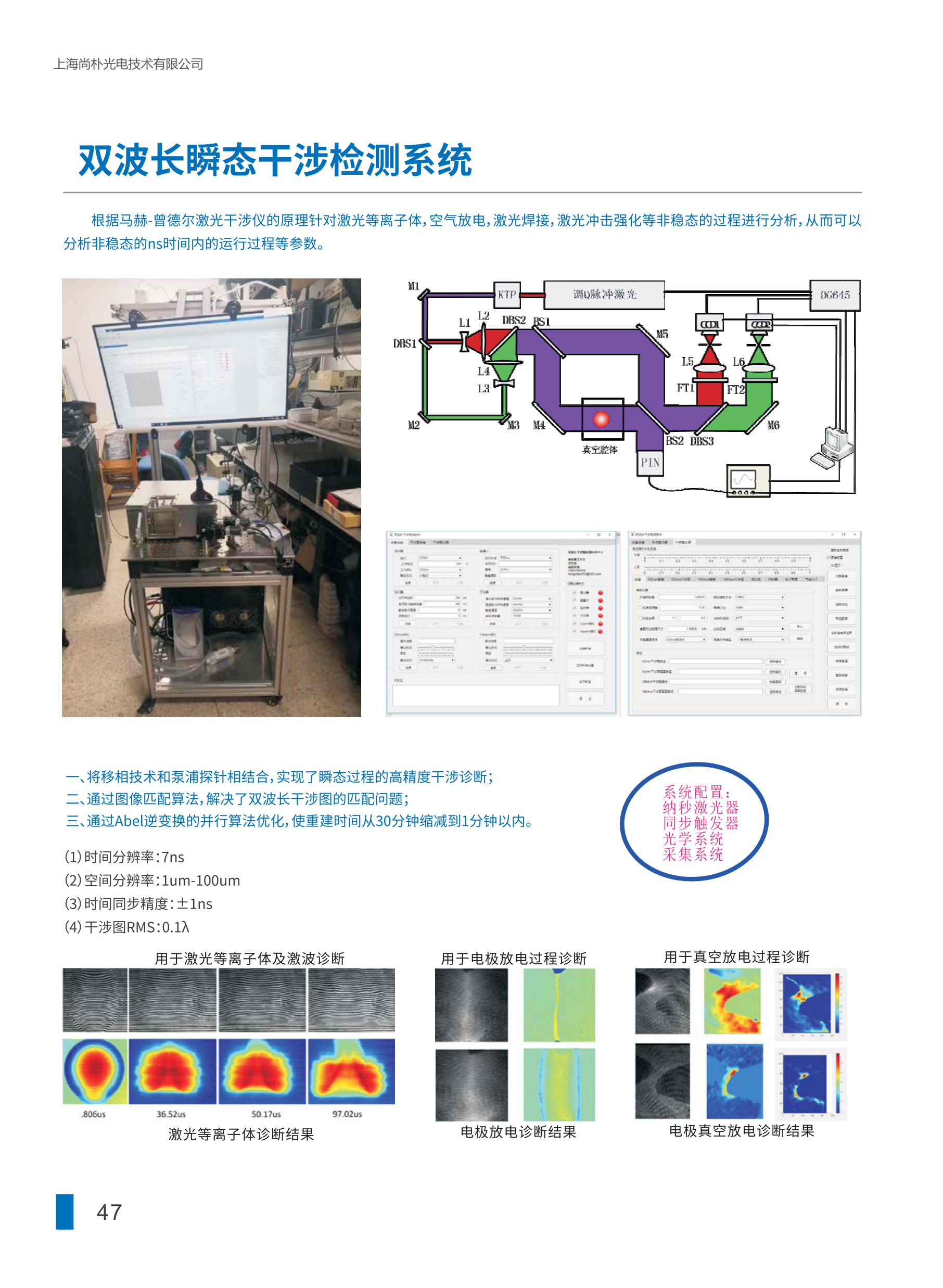
The Dual-wavelength Transient Interference Detection System is based on the Mach-Zehnder interferometer, providing ns-level high-temporal-resolution measurement of non-stationary processes including laser-produced plasma, air discharge, laser welding and laser shock peening. With 7ns temporal resolution, 1μm-100μm spatial resolution and ±1ns synchronization accuracy, it supports time-delayed double-exposure and shadowgraph imaging. Combined with self-developed reconstruction algorithms, it yields plasma phase shift, refractive index and electron density distributions for plasma diagnostics, detonation wave evolution and cavitation bubble dynamics.
Description
1. Overview
The Dual-wavelength Transient Interference Detection System is based on the Mach-Zehnder interferometer principle, designed for ns-level high-temporal-resolution measurement of non-stationary processes such as laser-produced plasma, air discharge, laser welding and laser shock peening. Dual-pulse solid-state lasers with time-delayed double exposure capture a sequence of interferograms of the transient process. The software reconstructs physical quantities including phase shift distribution, refractive index distribution and electron density distribution of the plasma. Shadowgraph imaging is also supported. It is widely used in research and industrial inspection involving high-power laser-matter interaction, plasma diagnostics, detonation wave evolution and cavitation bubble dynamics.
2. Principle & Key Specifications
The system uses a Mach-Zehnder interferometer as the core optical path. Dual-pulse solid-state lasers provide ns-level probe pulses; a digital delay generator precisely synchronizes the lasers, cameras and the event under test; high-resolution industrial cameras record interferogram sequences; a workstation with transient interferogram processing software completes phase reconstruction. Shadowgraph imaging is available to observe flow fields and morphology.
Key specifications:
· Temporal resolution: 7ns
· Spatial resolution: 1μm-100μm
· Time synchronization accuracy: ±1ns
· Interferogram RMS: 0.1λ
3. Main System Configuration
1. Pulsed solid-state lasers, 1-2 units (2 for time-delayed double exposure);
2. CW DPSS laser, 1 unit;
3. Digital delay generator, 1 unit;
4. Mach-Zehnder transient interferometer, 1 unit;
5. High-resolution industrial cameras, 2-4 units (4 for dual wavelength);
6. Photodetectors, 2 units (optional);
7. Image workstation, 1 unit;
8. Transient image acquisition software, 1 set (optional);
9. Calibration module, 1 set (optional);
10. Transient interferogram processing software, 1 set (optional);
11. Optical table and other accessories;
12. 500MHz oscilloscope, 1 unit (optional).
4. Software Processing Flow
The transient interferogram processing software integrates self-developed reconstruction algorithms with excellent noise immunity. Processing flow: Interferogram → FFT analysis & phase unwrapping → Phase shift distribution → Abel inversion → Plasma refractive index distribution → Theoretical approximation → Plasma electron density distribution. When the plasma phase field is approximately axisymmetric, plasma parameters such as electron density can be obtained directly by theoretical approximation.
5. Typical Applications
· Early-stage laser plasma evolution diagnostics (ns to hundreds of ns: interferograms and electron density maps)
· Late-stage laser plasma evolution and shock wave diagnostics
· Detonation wave formation diagnostics on laser-irradiated solid targets
· Laser cavitation bubble formation to collapse (shadowgraph)
· Electrode high-voltage discharge diagnostics
· Online inspection of laser welding, laser shock peening and other industrial processes
6. System Features
· Mach-Zehnder interferometer architecture with high accuracy and stability
· ns-level temporal resolution with ±1ns synchronization for fast transient processes
· Dual-wavelength / double-exposure options for multi-parameter joint diagnostics
· Self-developed image reconstruction algorithm with excellent noise immunity
· Modular configuration, flexibly selectable components on demand
Specifications
| 时间分辨率 | |
| 空间分辨率 | |
| 时间同步精度 | |
| 干涉图RMS |
Technical Data
System Schematic
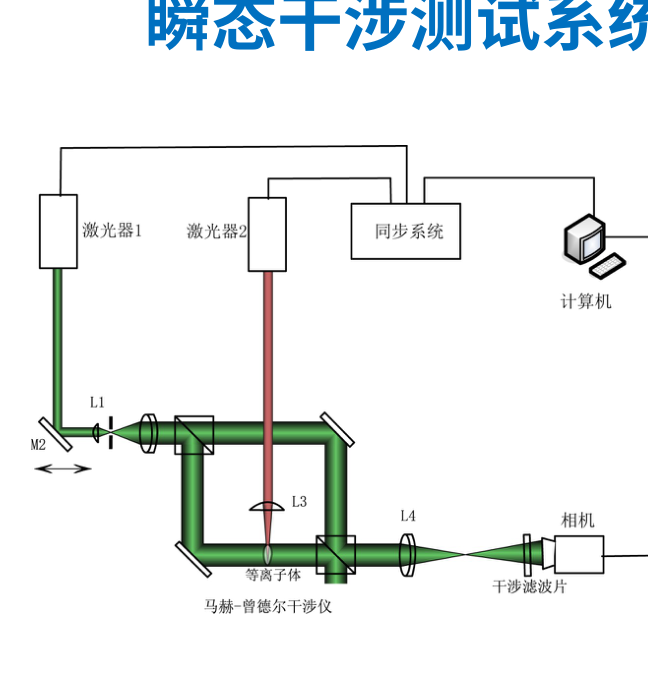
Optical path and hardware architecture of the dual-wavelength transient interference detection system based on the Mach-Zehnder interferometer: dual-pulse solid-state lasers are controlled by the synchronization system; probe beams pass through lens groups and mirrors into the interferometer; cameras record transient interferogram sequences; interference filters reject stray light; the workstation performs data acquisition and processing.
Key Specifications
· Temporal resolution: 7ns
· Spatial resolution: 1μm-100μm
· Time synchronization accuracy: ±1ns
· Interferogram RMS: 0.1λ
Transient Interferogram Processing Software Flow
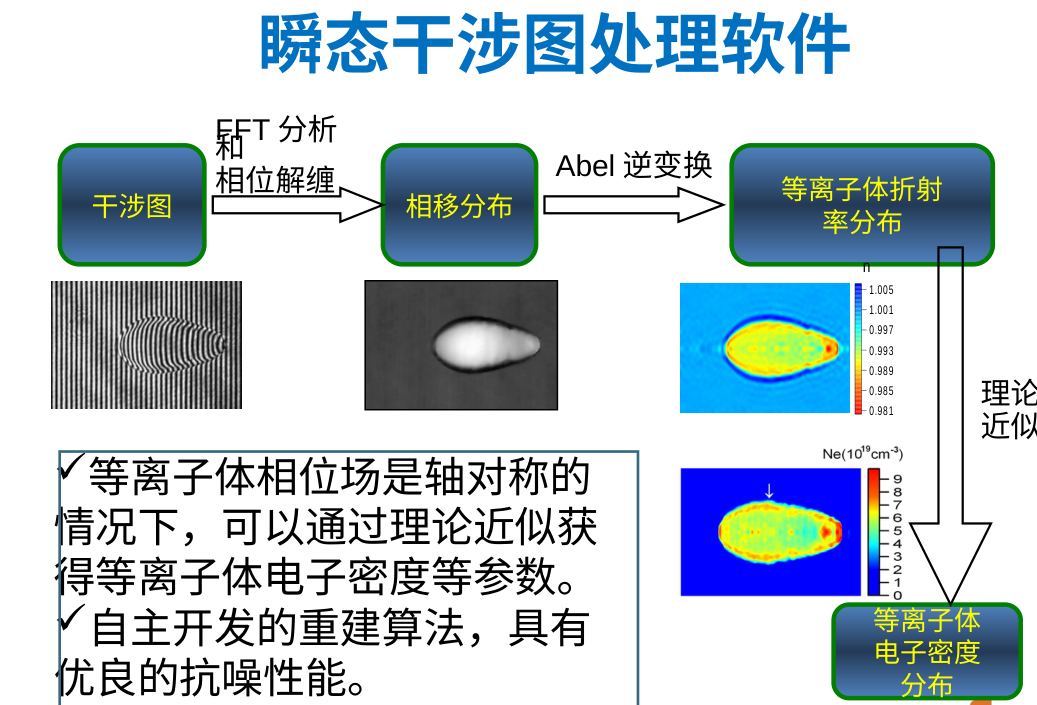
Interferogram → FFT analysis & phase unwrapping → Phase shift distribution → Abel inversion → Plasma refractive index distribution → Theoretical approximation → Plasma electron density distribution. The self-developed reconstruction algorithm offers excellent noise immunity; when the plasma phase field is approximately axisymmetric, parameters such as electron density can be obtained by theoretical approximation.
Typical application cases: early/late-stage laser plasma evolution (12ns-192ns, 0.8μs-97μs sequential imaging), detonation wave diagnostics on laser-irradiated solid targets, laser cavitation bubble formation to collapse (shadowgraph), and electrode high-voltage discharge diagnostics.