E-Laser Electronics Software Platform
Overview
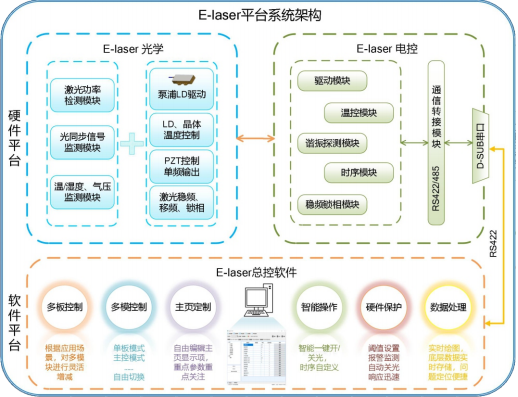
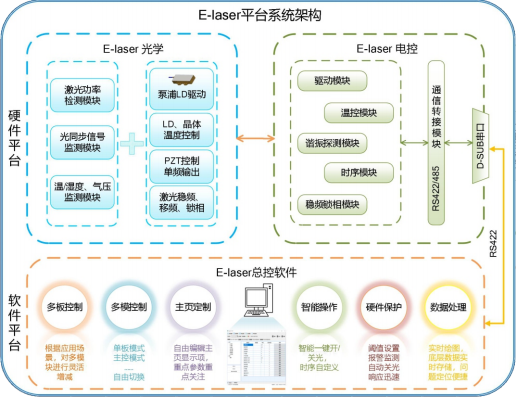
The E-laser platform is a client-side platform built on the concepts of "electronic" and "efficient," helping customers achieve DIY laser electronic control system design. The laser electronics team has been deeply engaged in laser electronics for decades, bringing together top professionals from home and abroad, and focusing on the development of precision laser electronics modules, system integration, and industrial development. Currently, it has highly mature modules such as LD drive, temperature control, photoelectric detection, arbitrary signal generator, resonance detection, frequency stabilization and phase locking, and data acquisition. With the help of the E-laser platform, rapid design and independent DIY of laser electronic control systems can be realized; through the E-laser platform, all module system integration can be achieved, enabling friendly interaction of laser electronic control systems.
Description

Multi-board Control
Users can flexibly add or remove modules according to different application scenarios, making it convenient and quick to DIY laser electronic control systems and conduct debugging.

Multi-mode Control
The software control modes are divided into: master control mode and single-board mode.
The master control mode is applicable to situations where users DIY a complete electronic control system with a large number of slave devices. In this mode, the software only communicates with the master control module, and all other modules are mounted on the master control module as slaves. All information from the slaves is uploaded to the master control module, which uniformly integrates and processes all information and then uploads it to the software in sequence.

The single-board mode is suitable for scenarios where users DIY simple driving, temperature control, monitoring, etc., with a small number of slave devices. In this mode, the software directly communicates with each module, and all information is directly uploaded to the software, which performs information integration and processing, replacing the function of the master control module.
Specifications
| Platform Architecture | As shown in the figure |